Key Specifications
CPUIntel Atom N270
GPUIntel Graphics Media Accelerator 950
RAM1GB
Storage80GB HDD
Display10" LED-backlit TFT LCD
Battery Life5 hours

MSI Wind U100 Laptop
Wind U100 netbook from 2008: 10-inch 1024x600 LED screen, 1.6 GHz Intel Atom N270, GMA 950, 1 GB RAM, 80 GB HDD, 1.2 kg and up to 5 hours of battery life.
Price information coming soon
🔔 Alert me when the price drops
✅ Done! We'll let you know when this model's price drops.
📣 Never miss a new model — follow us on Facebook · Instagram
MSI Wind U100 Laptop Specifications
| Display | 10" 1024x600 (WSVGA) |
|---|---|
| Panel | LED-backlit TFT LCD |
| Refresh Rate | 60Hz |
| CPU | Intel Atom N270 (single cores, 1.60 GHz) |
| GPU | Intel Graphics Media Accelerator 950 (integrated) |
| RAM | 1GB |
| Storage | 80GB HDD |
| Ports | 3x USB 2.0, VGA output, Ethernet, card reader |
| Wireless | Wi-Fi 802.11b/g |
| Battery Life | 5 hours |
| Weight | 1.2 kg |
| Dimensions | 260x180x35 |
| OS | Windows XP Home |
Suitability scores
Class scores out of 10 calculated from the specifications; not lab test results.
Gaming1see ranking →
Work & office3.3see ranking →
Portability9.5see ranking →
Design & video1see ranking →
Review
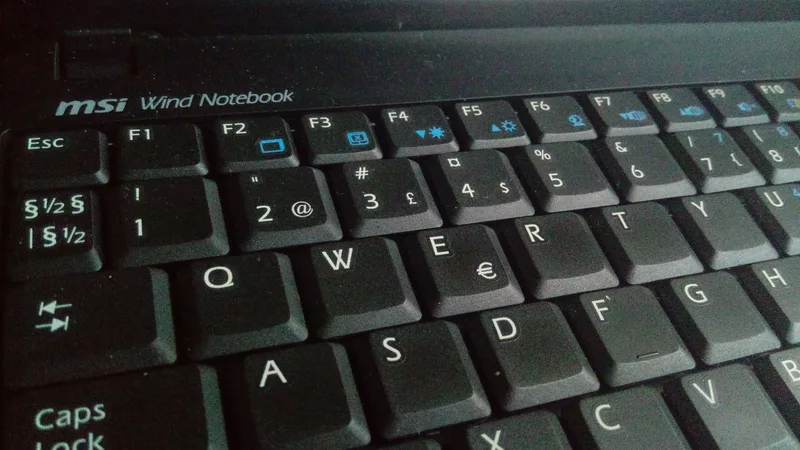
MSI Wind U100, released in 2008, holds a special place in MSI's laptop history as one of the most important models that popularized the "netbook" category of its era. One of the pioneers of the netbook market alongside the Asus Eee PC, this MSI laptop offered an extremely portable solution for its time with its compact 10-inch screen and a weight of just 1.2 kg. The Wind U100 was designed for users looking for a low-cost, energy-efficient computer for everyday use: web browsing, e-mail, word processing and the kind of light tasks that did not justify carrying a full-size notebook. The same design was also sold under other brand names in several markets, which is one reason the chassis is still so widely recognised today. Within MSI's laptop catalog it stands as the brand's first mass-market consumer hit, years before the gaming-focused lines that define the company now.
Where it sat in the first netbook wave
The netbook idea had been introduced a year earlier by the 7-inch Asus Eee PC 701, a Linux machine with a tiny screen and a few gigabytes of flash storage. The Wind U100 belonged to the second wave that arrived in 2008 together with the 8.9-inch Acer Aspire One A150 and the 10.2-inch Samsung NC10: all three moved to Intel's new Atom platform, used a conventional hard drive instead of small flash memory, and shipped with Windows XP. What set the MSI apart was the combination of a 10-inch panel, a comparatively roomy keyboard for the class and a familiar laptop layout, which made it feel less like a gadget and more like a small notebook. That recipe is essentially what the whole category adopted over the following two years.
Intel Atom N270 and GMA 950
Under the hood was an Intel Atom N270; this single-core 1.60 GHz chip was the backbone of the netbook philosophy of low power consumption and long battery life. The N270 belongs to Intel's Diamondville family, is built on a 45-nanometre process and supports Hyper-Threading, so the operating system sees two threads even though there is only one physical core. Its 512 KB cache and a power rating of just 2.5 W explain both its strengths and its limits: the chip barely needs cooling, but it executes instructions in order and cannot match even the entry-level Core 2 Duo laptops of the same year. It is also a 32-bit-only processor, which matters today because modern 64-bit operating systems will not install on it at all.
Graphics were handled by the integrated Intel Graphics Media Accelerator 950, which was sufficient not for heavy gaming or video processing but for comfortable basic web browsing, office applications and word processing. The GMA 950 shares the system memory and has no hardware decoding for high-definition video, so even standard-definition playback relied heavily on the processor. With 1 GB of DDR2 RAM and HDD options starting at 80 GB (120 GB and 160 GB versions were also available), the Wind U100 aimed to meet the era's need for a budget-friendly portable computer. The memory sits in a single slot, so the common upgrade of the time meant replacing the module with a larger one rather than adding a second stick.
Display, body and connections
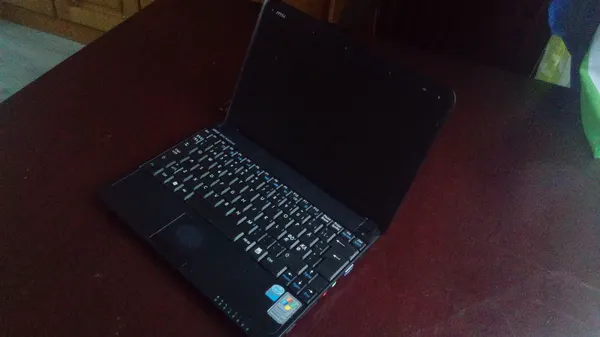
For the display, MSI chose a 10-inch WSVGA (1024x600) LED-backlit TFT panel; although this resolution is quite low by today's standards, it suited the nature of the netbook category. The 600-pixel height is the figure to keep in mind: many current web pages and dialog boxes assume at least 768 pixels, so some windows simply do not fit without scrolling. The LED backlight was a modern choice for 2008 and helped both thickness and power draw. The plastic chassis measures roughly 260 x 180 x 35 mm and weighs 1.2 kg, which still counts as light even by the standards of today's 13-inch ultraportables.
Connectivity covers the essentials of the period: three USB 2.0 ports, a VGA output for an external monitor or projector, wired Ethernet, a memory card reader and Wi-Fi 802.11b/g. There is no HDMI, no USB-C and no Bluetooth as standard on this configuration, and the Wi-Fi standard predates the 802.11n networks that became common shortly afterwards; it still connects to current routers, but only at the slow legacy rates. According to the manufacturer, the battery offered up to about 5 hours of use, a respectable figure for 2008 and one of the main arguments for the Atom platform over the faster but hungrier Core 2 chips.
Software: Windows XP and SUSE Linux
The Wind U100 shipped with Windows XP Home and was also sold with the Linux-based SUSE distribution. Windows XP has been out of support for many years, so a unit still running it should not be connected to the internet for anything sensitive. The practical route for the machine today is a lightweight 32-bit Linux distribution; because the N270 cannot run 64-bit systems, the choice is narrower than it used to be and shrinks further each year as distributions drop 32-bit builds. The Windows or Linux guide explains the general trade-offs, and for a machine of this class Linux is really the only current option.
What it can and cannot do today
Today this model draws the interest of retro computer enthusiasts on the used market and stands out as a historic MSI product that marks the start of the netbook era; apart from light text editing and trying out retro software, it is not suitable for active use by today's standards. Modern browsers with several tabs open overwhelm 1 GB of memory and a single in-order core, high-definition video stutters, and the 1024x600 screen clips many current interfaces. Where it still works well is as a distraction-free writing machine, a terminal for simple network tasks, a platform for period-correct Windows XP software kept offline, or simply as a collector's piece from the year the netbook became a phenomenon.
Buying one used
Because the newest units are well over a decade old, condition matters more than configuration. The hard drive and the battery are the two parts most likely to have failed: the drive can be swapped for a small SATA SSD, which makes the whole system feel noticeably more responsive, while replacement batteries are now mostly third-party cells of uncertain quality. Hinges, the power connector and the keyboard membrane are the other usual wear points on a netbook that was carried daily. Expect to pay very little; the model sits in the lowest tier of the used market, and a unit with the original box and charger is worth more to collectors than any hardware upgrade. The second-hand laptop checklist covers the general inspection steps.
Alternatives from the same era
Anyone collecting or comparing netbooks has several closely related choices. The Samsung NC10 used the same Atom N270 and GMA 950 with a 160 GB drive and a matte 10.2-inch screen, and the manufacturer quoted a longer runtime for it. The HP Mini 2140 brought a metal-clad business chassis and 2 GB of memory to the same platform in 2009, while the HP Mini 110 was HP's cheaper consumer take. The Asus Eee PC 1000HE of 2009 moved to the slightly faster Atom N280, and the earlier Eee PC 900 shows how small the category started before the 10-inch format took over. Among all of them, the Wind U100 remains the one most often remembered as the point where netbooks became ordinary laptops in miniature.
In short, the MSI Wind U100 is a pioneering and historically significant MSI notebook in the netbook category, with a low-power Intel Atom N270 processor and a compact 10-inch screen. Its full specs and used-market status are available on this page, and a longer assessment is in the MSI Wind U100 review.
Related Content
Featured Comparisons
Wind U100 vs Honor MagicBook 14 (R5/16GB/512GB)Wind U100 vs Huawei MateBook D14 2024 (i5-13420H/16GB/512GB)Wind U100 vs Lenovo ThinkPad E16 G2 21MA002UTXWind U100 vs MSI GX620Wind U100 vs MSI L1300Wind U100 vs MSI U270
All laptop comparisons →